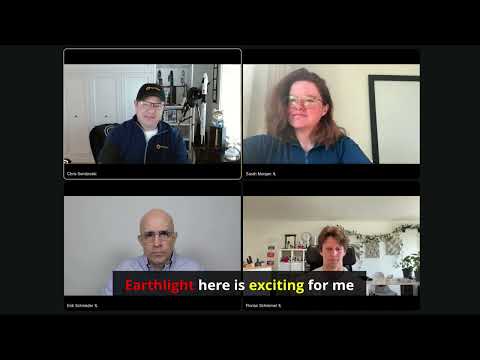
From a Kijiji Ad to the IES, Michael Jennison on Building Authority in Lighting from the Ground Up
Michael Jennison didn't plan a career in lighting. He answered a classified ad at 18 looking for a paycheque. What followed was two decades of building expertise the hard way, from the order desk to a boom truck 70 feet in the air in Canadian winters, from national accounts to retrofits across North America, until he became one of the most trusted voices in the Canadian lighting industry and VP of the IES Toronto Section. In Part 1 of this conversation, Michael shares what that journey actually looked like — and why the people who start from the bottom speak about their field differently than those who don't. Part of the Earthlight Skool Interview Series, hosted by astronaut and engineer Chris Sembroski. 🔗 Type 'LIGHT' in the comments for the free Designer's Value Engineering Cheat Sheet. 🔗 Join the Earthlight Intelligence Library: https://www.skool.com/parabolic-flight-2740/about?ref=3197752c9ea44794854776d39bfc2f09 🌐 earthlight.app Part 2 next week. #lighting #lightingdesign #IES #circadianlighting #Earthlight
Transcript
Welcome and Introductions
Host: Hello everyone, and welcome to Earthlight on Skool. My name is Chris Sembroski, and today we're having our first series of interviews with a special guest, Michael Jennison. This is our opportunity to really talk about the ups and downs of the lighting industry, and to share with everyone a little bit more about the Earthlight mission. First of all, I just want to say thanks, everyone, for joining. Spend your time on Skool as best you can to interact with other members as we start to grow this community. We're really excited about what we're going to be doing over the next several months, not just on Skool but in our company as well. So first of all, let's just welcome everyone and say, hey, thanks for joining the call today, everybody. It's going to be a casual conversation with lots of questions, but we do have some slides to share as well. So why don't we just jump right into it and say, Michael, thank you so much for joining today. Why don't we just turn it over to you, and you can introduce yourself a little bit.
Michael: Thanks for that warm introduction, Chris, and it's a pleasure to be a part of this. It's truly an honor and a pleasure to be here, so thank you for the hard work everyone's doing. My name is Michael Paul Jennison. I'm with a company called Omni Lumen Technical Products, and I'm vice president of the IES Toronto section. As cool or as pathetic as it sounds, lighting is a massive part of my life. I built my life around it, and my family. I believe strongly in education, mentorship. I love the technical luncheon program, and that's something that's very close to my heart. I'm a father; I have three young girls. I'm a husband; I love my wife. It's just a beautiful time of life as we're in a season of growth, and there's just so many things to be excited about. I jumped at the chance to be a part of this, and especially to see you, Chris, yourself, and Sarah Morgan and the rest of the team again here. Thank you for having me.
Host: Absolutely. I've got two girls, so you definitely have your hands full. I definitely know what this is about, and yeah, wonderful, beautiful family you've got there. We do all this stuff because we really care about where we come from, right, and what we're trying to support. I truly appreciate that about you particularly, Michael, and thank you so much for being willing to share this with us today. There's something really special about realizing that all the things that we do translate from space back down to the ground, and that light that we get to experience and these projects that we work so hard to accomplish. It really goes back to having meaning behind everything.
From a Kijiji Ad to the Lighting Industry
Host: Why don't we get a little bit more into more about you before we get to the complexity of some of these projects we have here. Can we start a little bit about the life you've built in this industry, Michael? Particularly when you zoom out and look into your journey a little bit more, from spec work to now stepping into the vice president role at the IES, the Illuminating Engineering Society. What do you feel like you're most grateful for in the way lighting has shaped your life, your family, and your relationships with designers like we see on the screen here?
Michael: Such a thoughtful question. There's so many things, and I'm really learning this more and more each day, but sometimes the most beautiful things in life are coming from the places that we least expect them. Lighting was really much that truth for me. I kind of got into lighting as a young person. I was 18, fresh out of high school, and I wanted to get some money in my pocket. I ended up just applying to a random job on Kijiji, and the classified was like shipping and receiving. I don't even know what that was. I just was looking for a change, and it just so happened that the company that I joined up with was a lighting company. So I kind of started from the bottom up in lighting.
I really started from picking and packing lamps, right? Like fluorescent tubes that were like 8 feet long, and trying to pack them into boxes. It was just like the most fragile thing you could ever imagine, right? Thin glass tube, like paper thin. And then trying to pack that and protect it in such a way that you could take it from Toronto to whatever, 4,000 kilometers or 2,500 miles in the opposite direction to the other side of the country, without it coming back to you. That was a big feat. But that's kind of where my interest in lighting started.
Learning the Trade the Hard Way
Michael: I kind of got into the order desk world, and I learned in troubleshooting kind of bizarre questions that a lot of electrical distributors, through their contractors, didn't really understand or were quick to answer. So it kind of put me in a situation where I had to learn very quickly. It was kind of like a sink-or-swim sort of situation, and I just embraced that. Back then, you didn't have the interwebs and the Googles to kind of fire up and ask AI for an answer on some of these things. So you would have to whip out the books, and they're big, like massive textbooks. You have to flip through all of them and try and find all the right performance information. And I liked that. It gave me kind of purpose. I felt that if I applied myself, there was a reward there. Even if it wasn't monetary, it was just the satisfaction of being able to do something that other people could do; it just required effort. A lot of people just didn't want to make that investment in time, and so I think I was rewarded for those investments.
I got into account management with lighting and started kind of taking care of the needs of national accounts. You know, like the Sport Cheks and the Foot Lockers and the different Loblaws and things like that that needed to order lamps and electrical components and lighting equipment for their stores across Canada.
Into the Field: Boom Trucks and Retrofits
Michael: Then I became a contractor. I got out in the field and I started working on a boom truck. We worked 70 feet up in the air. We were replacing high-mast pole lighting. We worked out there all day long, all year long. So we were turning into popsicles.
Host: Yeah. Oh, yeah. Popsicles.
Michael: We're turning into popsicles in the winter, and then in the summer, I mean, it gets crazy hot. But what a disorienting experience that was. It really gave me a lot of the practical to the theory that I was building, right? Without that, sometimes it's kind of one-dimensional. It was a really beautiful learning lesson, and I'm grateful for that, because I think it helped to crystallize some of the things that I was bringing to the table and helped give me a different perspective, a different edge, that other people just weren't coming with, right? They were coming with maybe some time on the counter. Maybe they went to like an Osram Sylvania fundamentals of lighting program or whatever, but they didn't really understand how lighting fit together. They could look at it on a piece of paper and say this is how it works, but actually getting your hands in there and making wired connections, being 75 feet up in the air, and a pole is moving back and forth, the boom truck is moving back and forth — it's a dynamic, it's a fluid situation. There's a part of it where sometimes you worry if you made the right choice to actually get in the truck that day. But anyways, as you can see, God had different plans for me. I'm alive and well today.
I sort of just started to kind of build on top of that, right? And then I got into retrofitting and auditing and stuff like that. I kind of traveled North America, and I started doing energy management verification, particularly with lighting efficiency upgrades. I spent a lot of time, and we had a lot of success there. I loved it; it was exciting. And then I got into the specification world and got involved in the IES. So it's a long story; it's not a simple one.
Shared Ground: Trading the Boom Truck for a Laptop
Host: No, but I think what I love about it is that it's a similar story to mine, right? I relate to it completely. Except while you're going 70 feet up in the air, I'm in the middle of Montana going like 70 feet into the ground at the silos, right? Still big boom trucks, taking that practical experience. And I love that you got into energy efficiency. It's really fun to hear someone else who's been doing things like that. I did it on the mechanical and control side for buildings for a long time. And yeah, I think you and I both traded in our ladder or boom truck for our laptops, right?
Transcript auto-generated from captions and lightly processed. It may contain errors.